
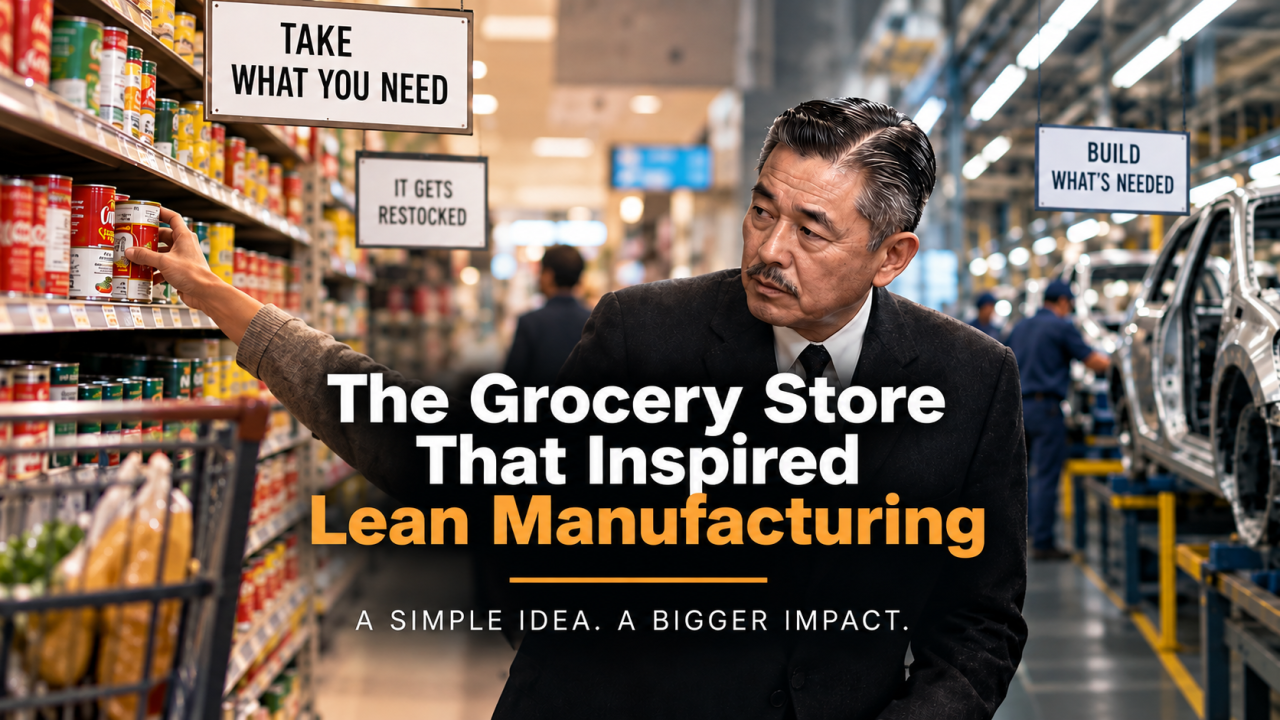
What does a grocery store have to do with lean manufacturing? More than you might think. In the 1950s, Toyota engineer Taiichi Ohno was looking for ways to help Toyota produce more efficiently in a very different economic environment from the massive American auto manufacturers. What caught his attention wasn’t a high-tech factory or a sophisticated piece of machinery. It was something much more ordinary: the way American supermarkets stocked their shelves.
From the Grocery Aisle to the Factory Floor
After World War II, Toyota faced a very different challenge from the major American automakers. The company didn’t have the same resources or production volumes, so it couldn’t simply build enormous quantities of vehicles, stockpile parts, and rely on economies of scale. Toyota needed to find a smarter way to produce what customers actually needed while keeping waste and excess inventory under control.
That challenge became a major focus for Taiichi Ohno, one of the key engineers behind what would eventually become the Toyota Production System.
During his research into American manufacturing and retail operations, Ohno became interested in the way supermarkets worked. Customers took products from the shelves, and the store replenished them based on what had actually been purchased. The store wasn’t simply filling every shelf with as much inventory as possible. Consumption created a signal for replenishment.
For most shoppers, that’s just how a grocery store works. But Ohno saw something much bigger.
What if a factory worked the same way?
Instead of producing huge quantities of parts and pushing them through a factory whether they were needed or not, each process could respond to what the next process actually required.
The Lean Enterprise Institute notes that Ohno used photographs of American supermarkets to develop the supermarket concept within Toyota, and Toyota established its first internal supermarket system in 1953. The idea became an important part of the Toyota Production System and helped shape the thinking behind pull systems and material replenishment.
The concept was simple: when something is used, replenish it.
What If a Factory Worked Like a Grocery Store?
Imagine a manufacturing facility producing thousands of components simply because the production schedule says they should be made. Those parts are moved to another area, where they sit waiting to be used. Eventually, they may be moved again before becoming part of a finished product.
The factory looks busy. Machines are running, employees are working, forklifts are moving, and inventory is piling up.
But is all that activity actually creating value?
This is where Ohno’s grocery store observation becomes powerful. Instead of constantly pushing materials forward based on forecasts or production capacity, a pull system allows actual demand to signal what should be produced or replenished. The next process effectively says, “We used this. We need another one.”
That thinking became closely associated with Just-in-Time manufacturing and systems such as Kanban, which use signals to control the movement and replenishment of materials.
The goal isn’t simply to have less inventory. It’s to create a smoother flow of work and avoid spending time, money, and space on things that aren’t needed yet.
The Bigger Idea Behind Lean
The supermarket story is memorable, but Lean Manufacturing is about much more than inventory. At its heart, Lean asks a simple question: What are we doing that doesn’t create value for the customer?
Think about a typical manufacturing or distribution operation. Materials wait for the next process. Employees walk long distances to retrieve tools or parts. Forklifts move material multiple times. Orders sit waiting for approvals. Defects create rework. Products are manufactured before customers actually need them.
Each problem may seem small. Together, they can have a major impact on productivity, lead times, operating costs, and customer satisfaction.
That’s why Lean isn’t simply about making people work faster or cutting expenses. It’s about understanding how work actually moves through an organization and removing the things that get in the way.
A facility can be incredibly busy and still be incredibly inefficient.
Busy Doesn’t Always Mean Productive
A forklift driving around the warehouse all day may look productive, but if it’s moving material unnecessarily, that motion isn’t creating value. An employee working overtime may appear highly productive, but if much of that time is spent correcting errors or waiting for information, those extra hours aren’t necessarily improving the process.
The American Society for Quality identifies common forms of Lean waste including defects, overproduction, waiting, underutilized talent, transportation, inventory, motion, and extra processing.
The biggest opportunities aren’t always dramatic. They might be the extra trip across a facility, the approval sitting in someone’s inbox, the inventory taking up valuable floor space, or the 30 seconds it takes an employee to find a component hundreds of times a day.
Those small inefficiencies add up.
Toyota Had a Bigger Problem to Solve
The grocery store was only one piece of the puzzle. Toyota continued developing Ohno’s ideas into a broader production system designed around efficiency, quality, continuous improvement, and responding to actual demand.
That was important because Toyota wasn’t simply trying to build fewer things. It was trying to build the right things, at the right time, in the right quantity, with as little waste as possible.
The result was the Toyota Production System, which eventually became one of the foundations of modern Lean Manufacturing. Concepts such as Just-in-Time, standardized work, continuous improvement, quality at the source, and respect for people became central to the system.
What started with an observation about supermarket shelves became a completely different way of thinking about how work should flow through a factory.

Technology Has Changed. The Questions Haven’t.
Manufacturing today looks very different from the 1950s. Companies have ERP systems, WMS platforms, robotics, automation, artificial intelligence, real-time dashboards, and Industry 4.0 technologies.
But the fundamental questions remain the same.
What does the process need? When does it need it? How much does it need? Where is the bottleneck? What is creating value, and what is simply creating more work?
Technology can provide incredible visibility, but it doesn’t automatically fix an inefficient process. A company can have a sophisticated ERP system and still carry too much inventory. A warehouse can implement automation and still have a poor layout. A manufacturer can collect enormous amounts of data and still struggle to understand why orders are taking too long.
In fact, automating an inefficient process can sometimes mean doing the wrong thing faster.
That’s why process improvement should start with understanding the operation before investing in the solution.
Start by Looking at the Work
One of the most valuable things an operations team can do is surprisingly simple: walk the floor.
Follow the material from the time it arrives until the time it leaves. Watch how employees actually perform the work. Look at where things wait, where they move, where they get stuck, and where employees have created workarounds.
Those workarounds can be especially revealing. If someone has developed their own system for finding a part, tracking an order, or getting around a bottleneck, there’s probably a reason.
Before adding equipment, expanding a facility, implementing another software platform, or automating a process, ask whether the existing process itself needs to change.
Sometimes the answer is technology. Sometimes it’s layout, training, better data, or simply eliminating a step that never needed to be there.
What the Grocery Store Really Taught Us
The most interesting part of the supermarket story may be how ordinary the original observation was. There wasn’t a revolutionary machine or complicated algorithm. There were shelves, customers, products, and a simple relationship between consumption and replenishment.
Ohno recognized that the underlying principle could be transferred to a completely different environment.
That’s at the heart of good process improvement. The best ideas don’t always come from looking harder at your own industry. Sometimes they come from looking somewhere completely different and asking whether the same principle could work for you.
The supermarket became one piece of a much larger system that Toyota continued developing. Those ideas eventually influenced Lean Manufacturing practices around the world.
And the lesson is still remarkably relevant:
Don’t make or move something simply because you can. Do it because it is needed.
Lean Manufacturing in Today’s Pacific Northwest
That principle applies whether you’re operating an aerospace facility in Everett, a manufacturing plant in Kent, a distribution center in Tacoma, or an industrial operation anywhere across the Pacific Northwest.
The equipment may be different. The software may be different. The products may be different. But the questions are often the same: Are we creating value? Where are we wasting time? Where is material waiting? What is creating unnecessary work? And what could we change to make the operation flow better?
At Kocer Consulting + Engineering, we help manufacturers and industrial businesses across the Pacific Northwest improve processes, reduce waste, optimize facilities, and implement systems that work for the way their operations actually run.
Ready to Improve Your Operation?
Let’s find the bottlenecks, waste, and opportunities hiding in your operation.
